
Key numbers
77 verified hail storms with stones of 1.75 inches or larger reached Travis County, which includes Austin, from 1984 to 2025 in the storm records we keep; the largest measured 5 inches (softball size) on May 20, 2011 (NOAA NCEI).
| Hail storms by decade, 1984 to 2025 | 1980s: 8, 1990s: 16, 2000s: 24, 2010s: 13, 2020s: 16 Source: NOAA NCEI |
|---|---|
| Largest hail | 5 in. (softball), May 20, 2011 Source: NOAA NCEI |
| Costliest hail storm | $160 million insured losses (2006 dollars), April 20, 2006 Source: Insurance Journal |
| 20 | NAHB's 2007 study puts gutter life at more than 50 years for copper and 20 years for aluminum. Source: National Association of Home Builders / Bank of America Home Equity, 2007 |
| 10 | In a 2019 IBHS ember-storm test, the half of a house with cedar siding, vinyl gutters and bark mulch ignited after 10 minutes, while the half with fiber cement siding, metal gutters and gravel survived. Source: IIBEC, 2019 |
A storm counts when NOAA lists a report in Travis County. Each hail size is the storm's largest report in the seven Austin-area counties, which may have fallen in a neighboring county, and insured losses cover every area the storm hit.
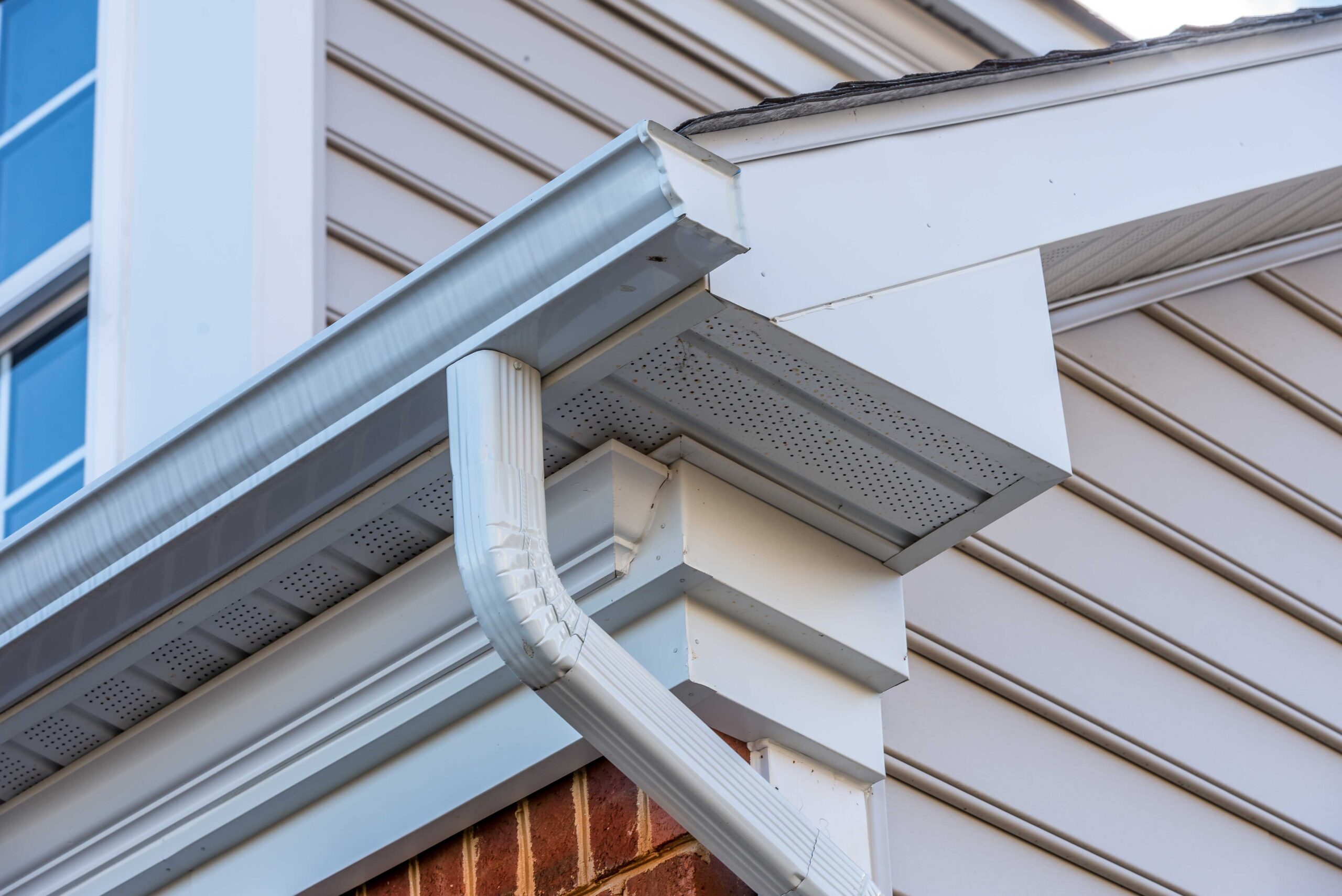
For most Austin homes, the best gutter system is seamless aluminum K-style gutters with more downspouts than you think you need, sized for heavy cloudbursts rather than average rain. Half-round gutters suit older and traditional homes, and box gutters suit modern designs. Add gutter guards if trees overhang the roof, and in a Wildland-Urban Interface zone choose noncombustible gutters, downspouts and guards. Then make sure every downspout carries water well away from the foundation.
Why Austin gutters are sized for downpours
Austin’s normal May rainfall is about 5 inches for the whole month, according to the National Weather Service’s Camp Mabry records. Yet the daily records include 6.16 inches on one May day and 8.56 inches on one July day. Gutters rarely fail on an ordinary shower; they fail when a storm drops inches in an hour and water sheets over the front edge, soaks the fascia and pours onto the slab. That is why we size gutters and downspouts for peak flow.
Our picks, by home type
| Home | Our usual pick | Why |
|---|---|---|
| Typical one- or two-story home | Seamless aluminum K-style, with extra downspouts | Custom-cut runs with no seams in the middle, good capacity, wide color choice |
| Long runs, steep roof or big valley | Larger K-style gutter or larger downspouts | More capacity where water concentrates |
| Historic or traditional home | Half-round in aluminum or copper | Classic look; we add downspouts to make up for smaller capacity |
| Modern home with clean lines | Box-style | Square profile, high capacity |
| Shed, carport or budget repair | Sectional | Lowest material cost; seams need upkeep |
The choice between seamless and sectional is the one homeowners ask about most; seamless vs sectional gutters compares them side by side.
Downspouts and drains: where most problems start
- Count. Too few downspouts is the most common reason a clean gutter still overflows.
- Size. A larger downspout moves more water and clogs less often.
- Placement. Put downspouts where valleys and long slopes deliver the most water.
- Discharge. Carry water several feet away with extensions, splash blocks or buried lines, onto ground that slopes away from the house.
- Harvest. A downspout can feed a rain barrel or tank; Austin Water lists rainwater harvesting rebates of up to $5,000 for residential systems.
Guards, trees and summer storms
Oak leaves, pollen and twigs fill Austin gutters fast, and a clogged gutter in a cloudburst overflows just like an undersized one. Gutter guards cut cleaning, but no guard is maintenance-free; plan to check them at least once a year. Overflow also speeds up summer roof wear at the edges; see how to spot summer roof damage in Austin.
Wildfire areas
The City of Austin’s WUI code lists noncombustible gutters and downspouts, with noncombustible, noncorrosive leaf guards, in all three zones. You can check your property on the City’s WUI map. Aluminum, steel and copper are noncombustible; vinyl and plastic guards are not.
What it costs
A new gutter system on a typical Austin home usually runs $1,000 to $2,500 installed, depending on footage, size, downspouts and guards. The full breakdown is in what new gutters cost in Austin.
Integrity Roofing and Painting is veteran-owned and family-run since 1990, with 650+ Google reviews and an Austin office on W US Hwy 290. See our Austin gutter services, call (512) 610-5897, or book a free inspection. We respond the same business day.
Sources: NWS Austin/San Antonio, Austin climate records, May and July (normals 1991 to 2020); City of Austin, Wildland-Urban Interface Code; City of Austin, Rebates, Free Stuff and Grants.
