
A storm tile roof replacement is one of the largest residential jobs we do, and this north Colorado Springs project shows why: about 60 squares of tile on a one-story home at a 6/12 pitch, insurance-funded, with the contract signed in July 2024 and the work photographed through September 2024. New gutters were part of the same job.
The problem
Storm damage left the tile roof in need of replacement, and the homeowner’s insurance funded the work. Tile itself can crack under hail, but the bigger issue on an older tile roof is usually underneath: the underlayment that actually keeps water out. Once a roof needs that layer replaced across most of its area, the tile has to come off anyway.
Scope
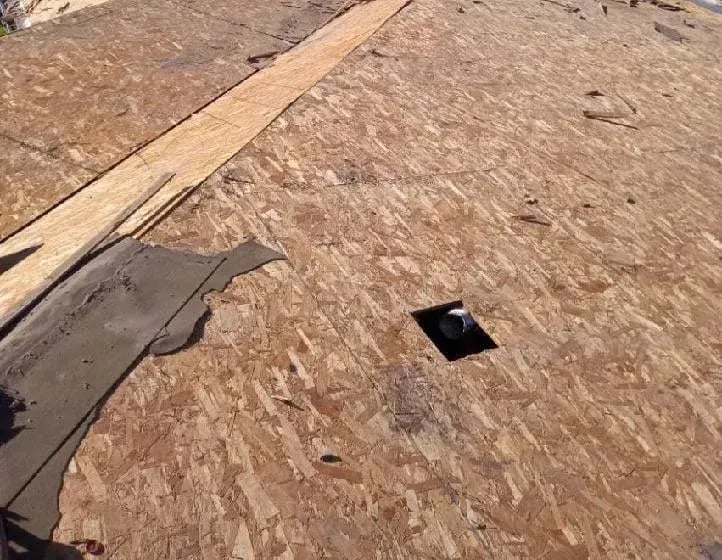
- Roof: full tear-off to the deck (first photo), new underlayment (second photo) and new red tile (third and fourth photos), about 60 squares.
- Profile and color: a red Spanish-style tile, matching the look of neighboring roofs visible in the last photo.
- Pitch: 6/12, a standard slope.
- Gutters: replaced as part of the project.
The process
- Structural check. Tile is heavy. PPRBD designs roofs in the region for a 30 psf flat-roof snow load below 7,000 feet and 40 psf at or above it, and tile sits on top of that as dead load. A house built for tile was framed for it; we confirm before ordering.
- Permit. Pulled through the Pikes Peak Regional Building Department, which handles roofing permits for Colorado Springs.
- Tear-off to the deck. Old tile and underlayment removed, deck inspected and repaired where soft or damaged (first photo).
- Underlayment and flashing. New underlayment across the deck, with valleys, walls and pipes flashed (second photo).
- Dry-in inspection. PPRBD inspects tile re-roofs at dry-in, before any tile covers the underlayment.
- Tile delivery and install. Pallets staged on site (third photo), then loaded and set course by course (fourth photo).
- Gutters, cleanup and final.
Timeline
Contract in July 2024; job photos in September 2024. Tile jobs run longer than shingle jobs because of the dry-in inspection hold point and the time it takes to set tile by hand.
What this project shows about tile roofs in Colorado Springs
- The underlayment is the roof. Tile sheds most water and protects the layer below; the underlayment keeps the house dry.
- Plan for the inspection pause. The dry-in inspection is built into every tile re-roof here. A good schedule expects it.
- Big roofs reward staging. Getting 60 squares of tile delivered, loaded and set without damage takes planning on the driveway as much as on the roof.
Compare clay, concrete and synthetic options on our Colorado Springs tile roofing page. For hail, see hail damage repair in Colorado Springs, and for the towns we cover north of the city, the El Paso County service area. See all recent projects.
Sources: PPRBD, Reroofing Guidelines (rev. 03/05/2024); PPRBD, Basic Design Information; International Code Council, 2021 IRC Chapter 9 (Section R905.3, clay and concrete tile).
Photos From This Project


Photos are from this job, edited to remove addresses, faces and license plates. Locations are given by town or area only.
Related Pages
More Projects
- Stone-Coated Steel Roof Replacement in West Colorado Springs (West Colorado Springs, 2024)
- Stone-Coated Steel Roof Replacement in Monument, CO (Monument, 2024)
- Commercial TPO Roof Replacement in Pueblo, CO (Pueblo, 2024)
Integrity Roofing and Painting is veteran-owned and family-run since 1990, an Owens Corning Platinum Preferred contractor with 650+ Google reviews. Call our Colorado Springs office at (719) 488-2800; we respond the same business day.
