
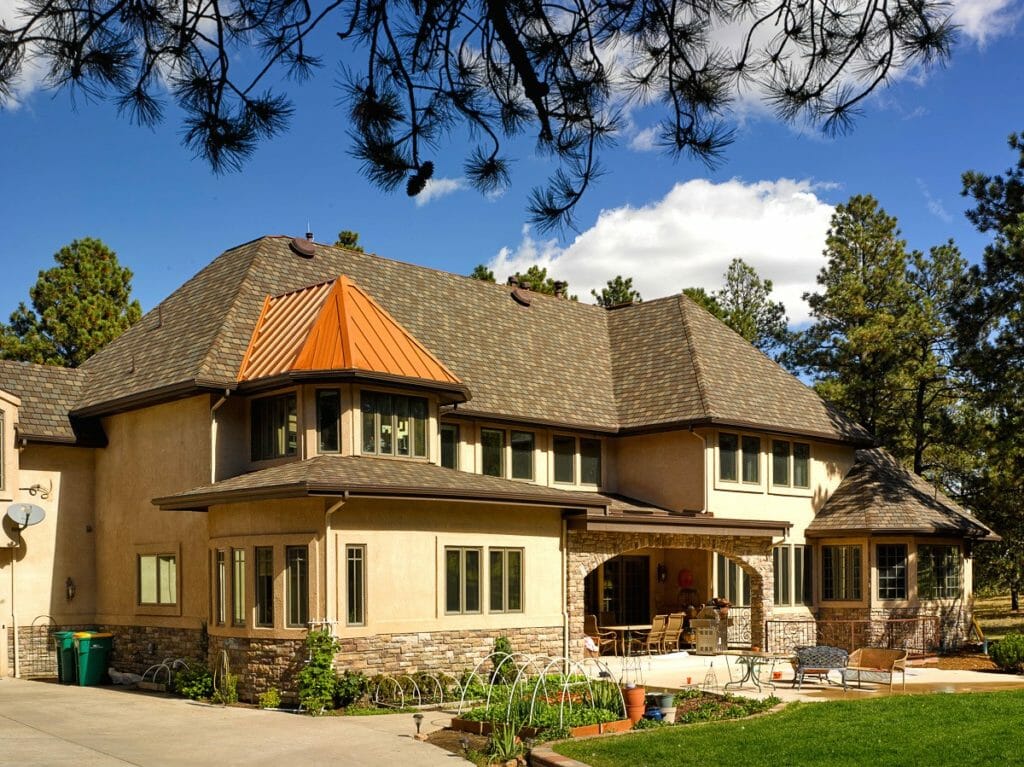
Roofers in Evergreen work for Jefferson County, not a town. Evergreen is an unincorporated community at about 7,160 feet, so Jefferson County Building Safety issues the re-roof permit, requires a complete tear-off with one layer of shingles, and inspects the roof twice in person: once at 10 to 25 percent complete and once at the end. In the county’s WUI Overlay District, permits applied for from July 1, 2026 fall under the Jefferson County Wildfire Resiliency Code, which requires a Class A roof assembly. Snow load rises with elevation, and Evergreen has had 1.75-inch hail as recently as June 2023.
Jefferson County re-roof rules at a glance
| Rule | What Jefferson County requires |
|---|---|
| Permit | Re-roof permit through the county’s online Citizen Portal. Repairs under 25% of the roof and not more than 2 squares (200 sq ft) are exempt (R105.2, county supplement) |
| Layers | One layer of asphalt shingles only. No overlays; complete tear-off required (R908.4, exception 4) |
| Ice barrier | Required for asphalt shingles, metal roof shingles, roll roofing, slate and wood (R905.1.2); tile per the manufacturer |
| Drip edge | Required at eaves and gables (R905.2.8.5) |
| Step flashing | Interlaced with each course along the sidewall (R905.2.8.3) |
| Wind | Shingles rated ASTM D7158 Class G or H, or ASTM D3161 Class A, D or F; county design wind speed 129 mph (Vult, Exposure B), with topographic effects |
| Inspections | Mid-roof at 10 to 25% complete, and a final. Photos are not accepted |
| Permit card | Posted where it is visible from the street, with safe access to the roof for the inspector |
| Other buildings | Each detached garage or accessory building needs its own permit |
| Wildfire | Class A roof assembly in the WUI Overlay District for permits applied for from July 1, 2026 (Jefferson County Wildfire Resiliency Code, section 402.2) |
Phone inspection requests are due by 5:00 p.m. the business day before; online requests can be made until 6:00 a.m. the same day. After the final passes, the inspector puts a signed green sticker on the permit card. Keep the card with your house records.
Snow load: why your elevation matters
Jefferson County replaced the standard snow load section with its own table, and it climbs fast through the Evergreen range. The minimum is 30 psf on the roof. From there:
| Elevation (ft) | Ground snow load (psf) | Roof snow load (psf) |
|---|---|---|
| 7,000 | 54 | 38 |
| 7,250 | 60 | 42 |
| 7,500 | 67 | 47 |
| 7,625 | 70 | 49 |
| 8,000 | 82 | 57 |
Homes in areas where the ground snow load is over 70 psf must be designed by a registered design professional. For a re-roof, the snow load matters most when the new roof is heavier than the old one: the county asks you to contact the Building Division before adding dead load for concrete or clay tile. Look up your address in the county’s Address Lookup to get your elevation.
The numbers are not theoretical. During the March 13 to 14, 2024 storm, NOAA recorded 61 inches of snow 5.4 miles northwest of Evergreen, and the April 15 to 16, 2016 storm left 29.5 inches near Evergreen. Snow that sits for days on a low-pitch roof is where ice dams start, and the county requires an ice barrier. A metal roof sheds snow quickly, so plan snow guards over doors, walkways and decks.
Sun and altitude
The EPA estimates that UV rises about 2 percent for every 1,000 feet of elevation, and that snow can reflect as much as 80 percent of UV. At about 7,160 feet, Evergreen sits roughly 1,900 feet above downtown Denver. Sun-facing slopes, rubber pipe boots and sealant joints take that exposure every day of the year, so they are worth a look on any inspection, even when there has been no storm.
Hail and wind in the Evergreen area
Elevation does not keep hail away. NOAA’s Storm Events Database lists:
- June 21, 2023: 1.75-inch hail in Evergreen, and 1.75-inch hail 1 mile west of town.
- June 22, 2023: 1.75-inch hail in Evergreen again the next day, with 2.50-inch hail 1.7 miles northwest of Indian Hills.
- September 6, 2019: 1.25-inch hail 1.7 miles northwest of Evergreen.
- May 28, 2018: 1.25-inch hail 1 mile west of Evergreen.
- June 8, 2026: 1.75-inch hail 2.2 miles west-northwest of Kittredge.
Wind is the other foothills hazard. On December 30, 2021, the day of the Marshall Fire, the National Weather Service in Boulder logged a 71 mph gust at Genesee, near I-70 northeast of Evergreen. Earlier, on December 31, 2011, a 96 mph measured gust was recorded in the NWS zone for Jefferson County above 6,000 feet. The county’s shingle wind ratings are in the table above. After a storm, see storm damage repair; the claim stays yours, and our photos make sure nothing gets missed in the scope. For more dates, see the Denver metro storm archive.
Evergreen and the Jefferson County wildfire code
On March 10, 2026, the county commissioners approved the Jefferson County Wildfire Resiliency Code, updates to Zoning Resolution Section 39 and a new WUI Overlay District map. It applies to permits applied for from July 1, 2026, on unincorporated property inside the overlay, and the county says it updated its standards to meet the 2025 Colorado Wildfire Resiliency Code. For an Evergreen roof:
- Class A. Roof assemblies in the overlay must be Class A.
- The 25% rule. If 25% or more of the roof is replaced, the entire roof must be a Class A assembly when the job is done. Repairs under 25% of the roof and not more than 2 squares need no permit.
- No defensible space for a re-roof. The county says re-roofing does not require defensible space. Re-siding does: for a re-siding permit, the owner may self-inspect Zone 1 (0 to 5 feet) and sign a county attestation form instead of hiring a Wildfire Mitigation Specialist.
- No new fees. The county charges no extra fee for the wildfire review beyond the building permit fee schedule.
Check your parcel on the county’s WUI Overlay District map before you get bids. Our wildfire home hardening guide explains the whole house, and our guides cover Class A roofs, ember-resistant vents, gutters and embers, WUI siding and decks, defensible space zones and how the state code works on a reroof.
What we do on Evergreen homes
We install Class A asphalt, metal and tile roofs, and our standard roof valley detail meets the code. We install ember-resistant vents, metal gutters and siding, so the roof edge and the walls can be handled on one job. We do not do landscaping or fuel reduction; for that, contact your fire district or the Colorado State Forest Service.
Nearby towns
Down the hill, see Morrison, where the Town of Morrison permits inside its limits, and Golden, which splits between the city and the county. East of the foothills, Lakewood runs its own building department. For leaks, see roof repair. See all Denver-area towns we serve.
We are veteran-owned and family-run since 1990, an Owens Corning Platinum Preferred contractor, with 650+ Google reviews, and we reply the same business day. Call our Centennial office at (303) 209-0152 or book a free roof inspection.
Sources: Jefferson County, Re-Roofing and Residing; Jefferson County Building Safety, Important Notice on Roofing (2024 code, July 1, 2026); Jefferson County, Table R301.2(1) Climatic and Geographic Design Criteria; Jefferson County, Table R301.2.3 Snow Load Table; Jefferson County, Defensible Space and Wildfire Mitigation; Jefferson County, Wildfire Resiliency Code; US EPA, A Guide to the UV Index; NOAA NCEI Storm Events Database, events 1107264, 1107260, 1108828, 1108979, 843384, 747515, 1330943, 1156371, 630297, 990831 and 357341; elevation from the USGS Geographic Names Information System.
Hail history near Evergreen
The 4 storms with the biggest hail that reached Jefferson County, from NOAA and insurance-industry records. Each size is the storm's largest report, which may have fallen in a neighboring county, and insured losses cover every area the storm hit.
- July 13, 2011: hail to 4.5 in. (softball), $164.8M insured (2011 dollars). Source: Rocky Mountain Insurance Information Association (RMIIA, now RMIA)
- June 6, 2009: hail to 3 in. (teacup), $353.3M insured (2009 dollars). Source: RMIIA
- June 13, 1984: hail to 3 in. (teacup), $276.7M insured (1984 dollars). Source: Rocky Mountain Insurance Information Association (RMIIA, now RMIA)
- June 18, 2018: hail to 3 in. (teacup), $276.4M insured (2018 dollars). Source: RMIIA
